How to Brief Your Board on AI in One Page
A one-page board AI brief: what staff use, privacy fences, what's in and out of scope, reserved human decisions, and a 90-day pilot ask.
Board Governance Executive
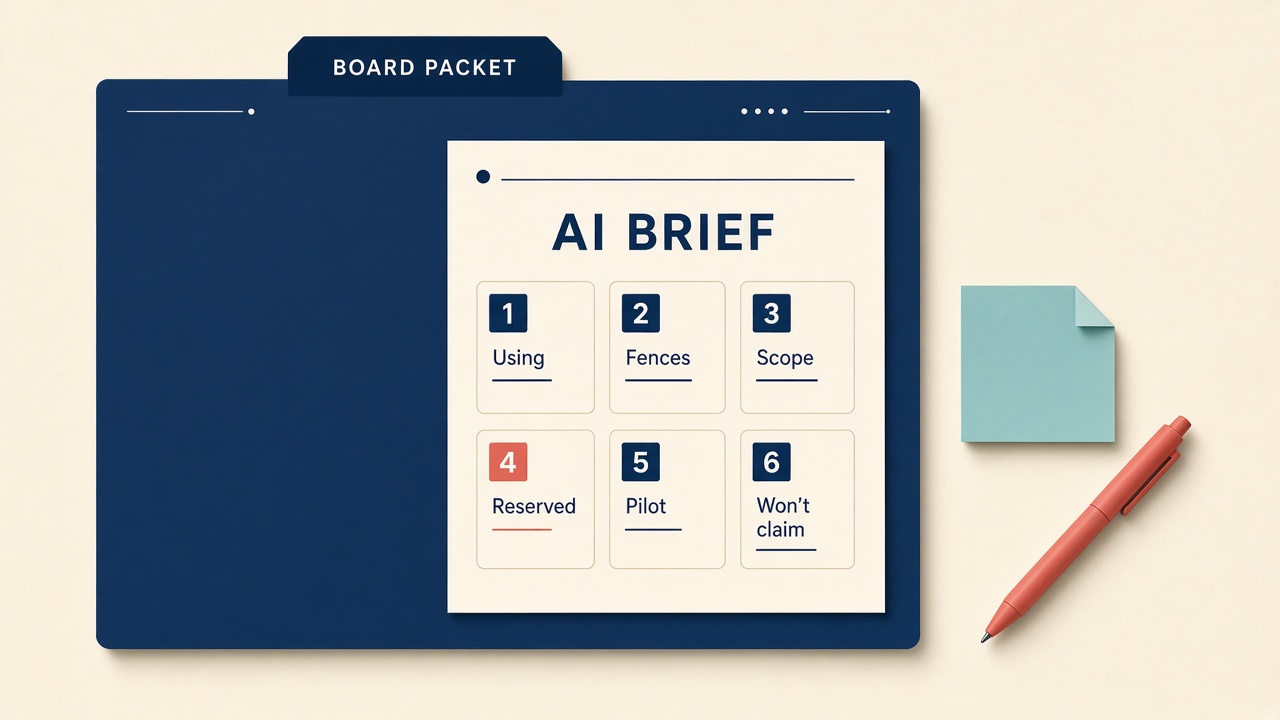
Board packet locks Friday. A director asked for “something on AI.”
You can drop in a vendor deck, a glossary dump, or a product demo that never asks the board for a decision. Directors leave unclear on risk, pilots, and who decides, or they green-light spend on hype. Fiduciaries need a briefing they can read in three minutes and a talking sequence staff can voice in five: what you’re using, privacy fences, what’s in and out of scope, which decisions stay human, one 90-day pilot ask, and what you will not claim. Humans own fiduciary decisions. This week’s deliverable is one page, not a 40-page policy rewrite.
What association, nonprofit, and government practice already implies
NTEN / ANB Advisory board talking points push an accessible one-sheet into the packet, not a dense deck. Prep ahead; co-craft with the board chair when your culture expects it. Don’t adopt from fear or hype. Name risks (bias, dehumanizing interaction, inaccurate content) and mission-aligned uses. Seek support for a policy and for tool and staff-time costs. If you propose a use case, say where it sits, who uses it, mission benefit, effort, and cost. Principles to keep light: accountability, equity and access, fairness, reliability, transparency, trust. AI supports human decision-making; it does not replace it. NTEN’s generative AI use policy template is the fuller living-policy project (approved tools, no personal accounts for org work, minimize personal data in prompts, human review). Point there later. This week’s job is the board memo.
Donna Oser’s MSAE Impact piece on board AI governance (Spring 2024) frames four steps: Education, Exploration, Determination, Implementation. Your one-pager covers Education plus a Determination ask. Exploration is the meeting conversation. Implementation sits with the chief staff executive: training, communication, monitor and revise.
Association Leadership is plain: boards will have the AI conversation sooner or later. Frame pros carefully (decision support, summarization) and cons plainly (errors needing verification; no morals of their own; consumer chatbots are not secure channels for confidential data). Risk management is not avoidance. Start small on rote or admin tasks. AI supplements human judgment; it does not replace the board’s values and expertise.
ASAE’s “AI as Strategic Enabler” (Miller Liu & Goodwin, March 2026) notes many association executives feel underprepared. Leadership moves: treat AI as a mission enabler, prioritize upskilling from the top, augment human expertise rather than replace it. ask for literacy plus one pilot tied to a real member or mission problem, not a vague “AI strategy” slide. ASAE’s organizational AI policy makes the reserved-decisions block non-negotiable: humans verify and own outputs; protect member PII; use approved tools; be transparent when AI meaningfully shapes member-facing work; do not rely on AI for final decisions about hiring, personnel, or member standing.
NIST’s AI Risk Management Framework gives boards a shared vocabulary: Govern / Map / Measure / Manage. The Generative AI Profile (NIST AI 600-1) flags confabulation (confident wrong answers) and Human-AI Configuration risks such as automation bias. One glossary card in the packet is enough. The FTC’s Operation AI Comply crackdown on deceptive AI claims is the “won’t claim” block: no invented productivity lifts, member-growth promises, or “AI-powered” labels you cannot substantiate.
The FSAE / Association Societies Alliance survey (November 2024) found only 13% of responding associations reported an organizational AI policy. Privacy and accuracy barriers rank high. Many boards are starting from little written guidance; a one-page brief is a reasonable first packet insert, not a failure to have a 40-page policy yet. Independent Sector pushes data policies and baby-step pilots before big bets, with human verification where policy requires it.
Shared vocabulary for generative AI lives lightly in the Day-1 staff primer. A full staff acceptable-use one-pager is separate work. This brief is the board packet insert.
The one-page template (six blocks)
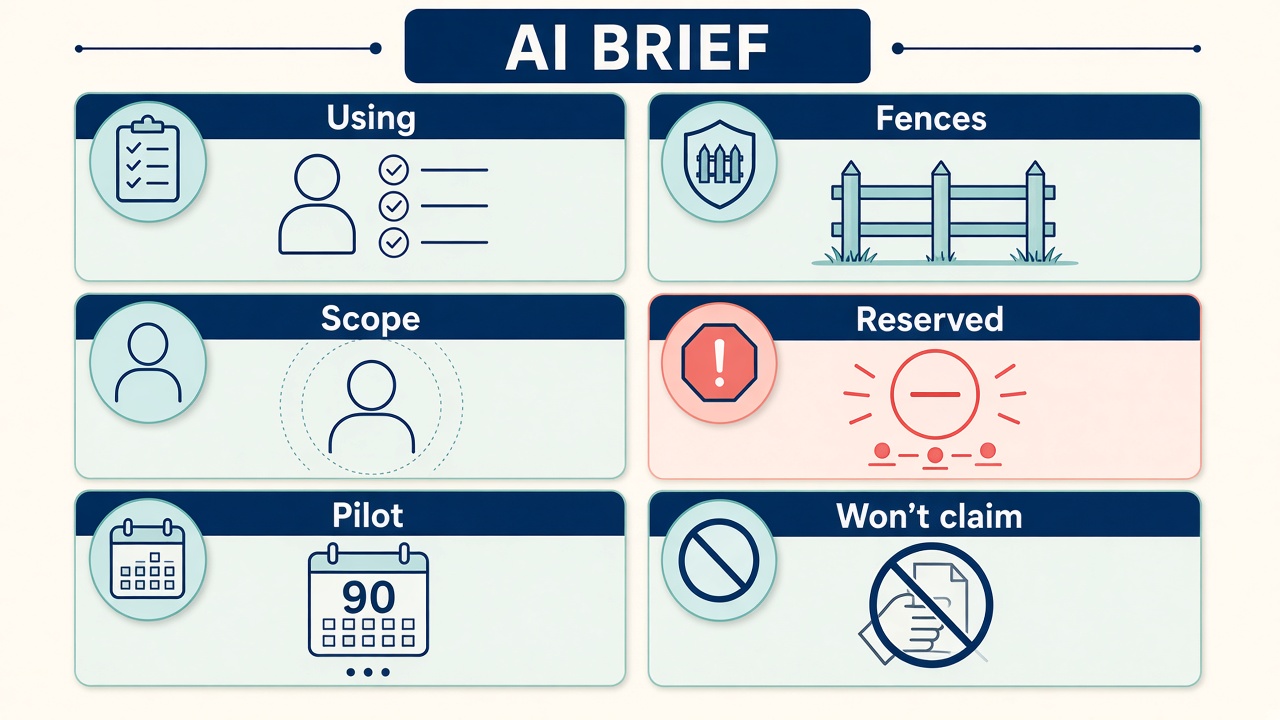
Print or paste this shell into the packet. Fill blanks with your real tools, fences, and one pilot, not a vendor roadmap. Label anything invented as illustrative. This is not legal advice.
Illustrative memo:
TO: Board of Directors
FROM: [CEO / Board liaison]
RE: AI at our association: status and 90-day ask
DATE: [packet date]

1) What we’re using today
- [Tool A]: drafting member emails from approved website copy (staff review before send)
- [Tool B]: summarizing public agenda packets for staff prep (not for confidential exhibits)
- Shadow use: [unknown personal accounts]; we will bring under an approved-tool rule

2) Data and privacy fences
- No member PII, AMS exports, donor notes, certification records, or confidential board
  exhibits in consumer AI tools
- Org/approved accounts only for association work
- Humans review outputs before publish, send, or act

3) In scope / out of scope (this quarter)
- In: drafting and summarizing from approved or public source text; internal brainstorming
- Out: member standing decisions; dues changes; hiring; advocacy position language; legal strategy

4) Decisions reserved for humans (fiduciary)
- AI may draft or summarize. The board and named staff decide. No automated final decisions
  on money, membership status, personnel, or public positions.

5) 90-day pilot ask
- Pilot: [one sentence]
- Owner: [name] | Success metric: [one measurable] | Stop rule: [when we halt]
- Budget: $[x] + [y] staff hours | Report back: [next board date]

6) What we will not claim
- We will not publish unverified time-saved or growth numbers tied to AI
- We will not label member programs “AI-powered” without a clear, truthful description
- We will not treat model output as fact without a human check

Next review: [date]. Full staff acceptable-use note follows separately.
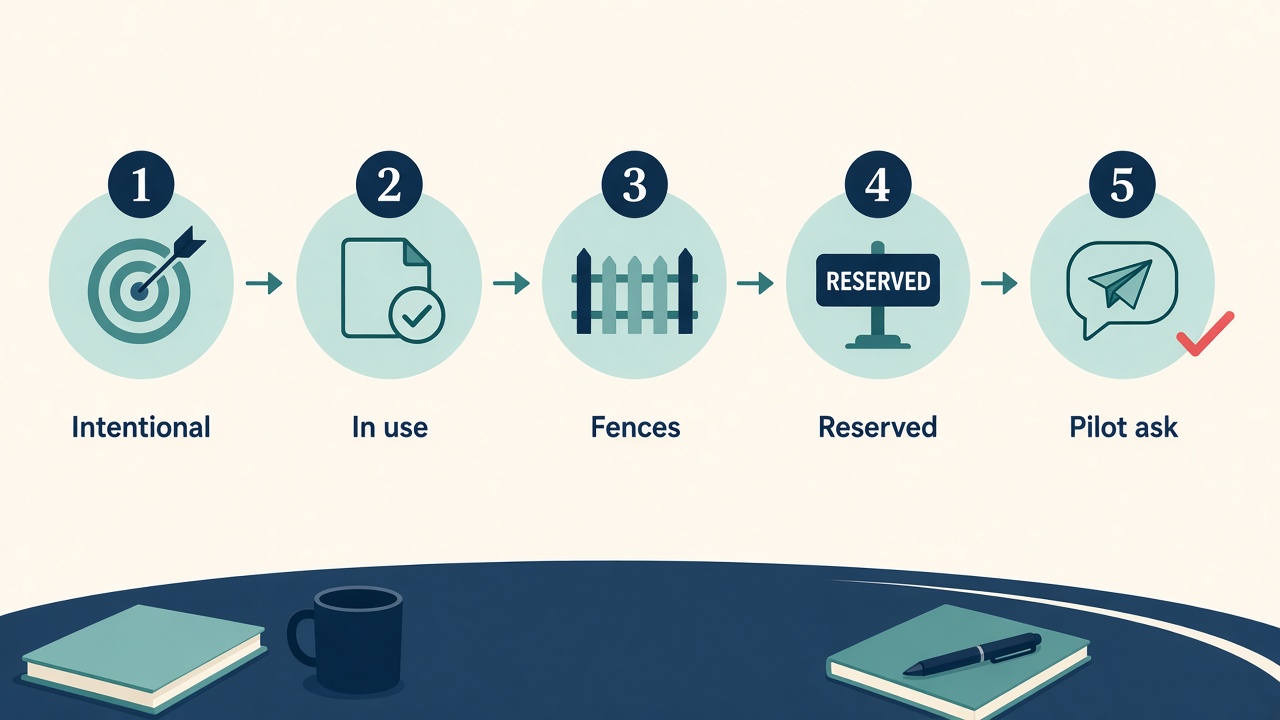
Talking sequence (~5 minutes): (a) Why we’re intentional, not panicked; (b) what’s in use; (c) fences; (d) reserved decisions; (e) one pilot ask; (f) what we won’t claim; (g) next review date. Invite Exploration questions (pace, risks of action versus inaction) without promising a strategy theater session. Optional packet add-on: a half-page NIST Govern / Map / Measure / Manage glossary card. Dry-run the sequence with the board chair if your culture expects it.
This week’s moves
Build the one-pager before Friday’s packet lock.
- Inventory what’s already in use: Ask three people (membership, comms, ops) which AI tools they touched this month. List tool name, use (drafting, summary, research), and whether it’s a personal or org account. Cap the memo at the top three. Note unknowns as “shadow use; needs policy.”
- Open a one-page memo shell with six headings: (1) What we’re using today, (2) Data and privacy fences, (3) In scope / out of scope, (4) Decisions reserved for humans, (5) 90-day pilot ask, (6) What we will not claim. One page means one page; cut until it fits.
- Write the fences in plain words: Approved tools only (or “none approved yet; pause member, financial, and privileged data”); no AMS exports, donor notes, certification records, or board-packet confidential items into consumer chat; personal accounts off-limits for association work. Point to NTEN and ASAE themes; do not paste their policy text.
- List reserved human decisions: At minimum: dues and pricing, member standing and discipline, hiring and personnel, advocacy positions, legal or privileged strategy, and any fiduciary vote. Line the board can hear: AI may draft or summarize; humans decide.
- Pick one 90-day pilot: Mission-aligned, non-critical path, measurable (example: staff meeting notes summary from approved public or agenda text only; or renew-email draft from approved benefits copy with human send). Name owner, success metric, stop rule, and budget (even if $0 plus hours).
- Write the “won’t claim” block: No unverified time-saved percentages, no “AI will grow membership,” no “AI-powered” member promises you cannot prove. (FTC: don’t overclaim.)
- Packet it: Add the one-pager to the board packet; optional half-page NIST Govern / Map / Measure / Manage glossary card; optional link to your draft acceptable-use note (or “coming next”). Co-review with the board chair if your culture expects it.
- Dry-run a five-minute talking sequence: Intentional, not panicked; then top uses, fences, reserved decisions, one pilot ask, won’t-claim, and next review date. Time it aloud. Save the winning memo as
Board-AI-brief-YYYY-MM.mdwith a version date.
Pitfalls
Treating a vendor deck as the brief. Directors need your tools, fences, reserved decisions, and one ask, not a product roadmap. Cut the PDF; keep the one-pager.
Dumping vocabulary with no ask. Shared terms help; a glossary alone does not. Pair literacy with a Determination ask (pilot + review date). For definitions, point staff to the Day-1 primer.
Promising ROI you can’t measure. Skip invented time-saved or membership-growth numbers. Use only attributed figures you checked (such as the FSAE/ASA November 2024 13% policy figure above). Name one measurable pilot metric instead.
Pasting board packets into consumer chat. Confidential exhibits, AMS exports, donor notes, and certification records stay out of personal or unapproved tools. Summarize from approved or public agenda text only.
Letting AI “recommend” dues or discipline. Member standing, pricing, hiring, advocacy positions, and fiduciary votes stay human. AI may draft or summarize; named people decide.
Skipping reserved-decision language. If the memo never says who owns the final call, the room fills the gap with hype or fear. Put the fiduciary line on the page.
Turning this into a full policy rewrite. Staff acceptable-use and a living AI policy are real work, but separate from this memo. Skip product stacks and architecture tours; fiduciaries need fences and an ask, not a build plan.
Sources
- NTEN / ANB Advisory - Board Talking Points for AI Policy (PDF)
- NTEN - Generative AI Use Policy Template (PDF)
- MSAE Impact - Engaging the Board in AI Governance (Donna Oser, CAE)
- Association Leadership - Inviting AI into the Association Boardroom
- ASAE - AI as Strategic Enabler
- ASAE - Organizational AI Policy
- NIST - AI Risk Management Framework
- NIST AI 600-1 - Generative Artificial Intelligence Profile
- FTC - Operation AI Comply / Crackdown on Deceptive AI Claims
- FSAE / Association Societies Alliance - AI Usage in Associations Report
- Independent Sector - Five Steps to Unlock AI’s Potential for Nonprofits