Tutorial
BeginnerCheck AI-Drafted Board Minutes Motion by Motion Before the Board Approves Them
Before AI-drafted minutes go to the chair, compare every motion with the recording and the agenda: whether it was made, who moved and seconded it, what happened to it and how the vote was counted.
Time needed: About 45 minutes for a board meeting with six motions
Before you start:
- The AI-drafted minutes, still marked as a draft
- The meeting recording or transcript
- The meeting agenda as it was sent to the board
- A browser to run the lab
Governance Board Relations AI Literacy Meetings
By the end, every motion in a set of AI-drafted board minutes will have been compared with the recording and the agenda: whether it was made, who moved and seconded it, what became of it, and how the vote was counted. Each motion gets a STOP, FIX or PASS before the draft reaches the chair.
Try it now: the draft minutes motion check lab holds six practice versions of one October board meeting, six motions each, for an association that does not exist. Type a code for each field and the page gives every motion a verdict. It runs in your browser, sends nothing anywhere, and no AI takes part.
What each motion has to show
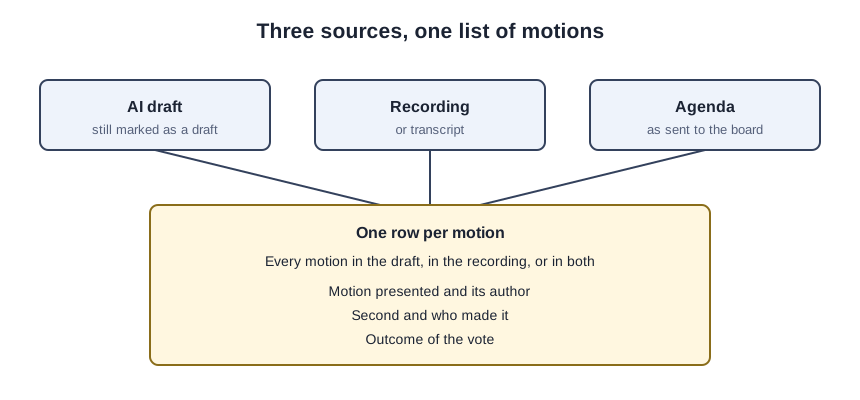
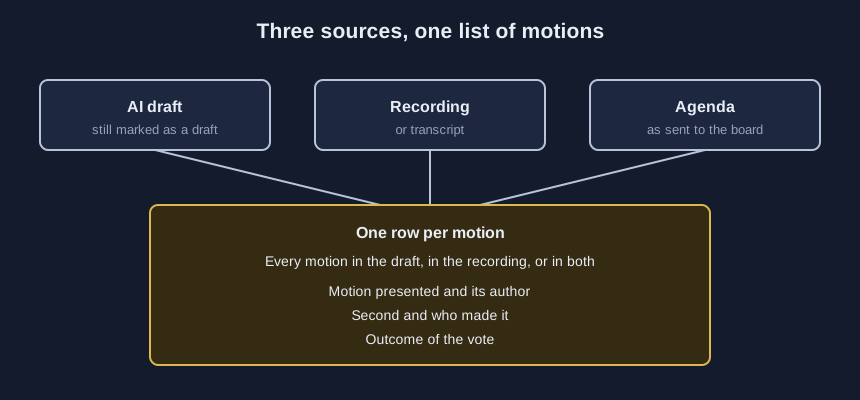
The checklist comes from “Effective Board Management,” a training deck Tim Rusk of the Nonprofit Association of Oregon presented at an Oregon Department of Justice summit in 2024. For each board decision, the deck lists three things to record: “Motion presented and its author,” “Second and who made it,” and “Outcome of the vote.” Its voting steps run from a motion to “Another board member seconds the motion” to a yay, nay or abstention, and then “The motion and the result of the vote is recorded in the minutes.”
The deck says nothing about AI; using its three items to check an AI draft is our application. The same deck also states, as a requirement, that “Organizations are required to record all actions taken by directors … and to keep all minutes as permanent records.” Rules vary by state and by bylaws, so check with your counsel or parliamentarian before treating any of this as what your own minutes must hold.
For why an AI summary makes a weak starting point, read our article on what AI meeting summaries can leave out.
The check, in seven steps
- Open the three sources side by side: the AI draft, the recording or transcript, and the agenda. Keep the draft labeled as a draft until the last step.
- List every motion from both directions. Make a row for each motion the draft records and each one you hear in the recording, even if it shows up in only one.
- Mark where the motion appears. In draft is Y or N. In recording is Y, N, or U when you cannot tell because of an audio gap, crosstalk or a stopped recording.
- Compare the mover, the seconder and the outcome for each motion found in both places. Use S for a match, D when the draft differs, and M when the draft leaves it out. The seconder also takes X when there was no second in the recording and the draft shows none.
- Compare the count and any abstentions, using S or D, or V for a voice vote with no count on either side. The deck treats abstaining as its own choice, separate from yay and nay, so “carried unanimously” is wrong whenever someone abstained.
- Check the agenda. Y when the motion’s item appears on it, N when it does not. A motion missing from the agenda gets flagged for the chair to explain; the check does not call it invalid.
- Type the rows into the lab and clear every STOP before any FIX. Correct the draft, re-enter the row, and repeat until each motion passes, then send the draft to the chair.
How the lab reaches a verdict
The lab tries ten rules in order and keeps the first that fits. A blank, a lowercase letter, an unlisted code, or a row in neither the draft nor the recording is a FIX under R1. The three STOP rules come next, as the diagram shows. A motion the recording cannot confirm is a FIX (R5), and its field comparisons are skipped because there is nothing to compare against. The other FIX rules follow, and everything else is a PASS under R11.
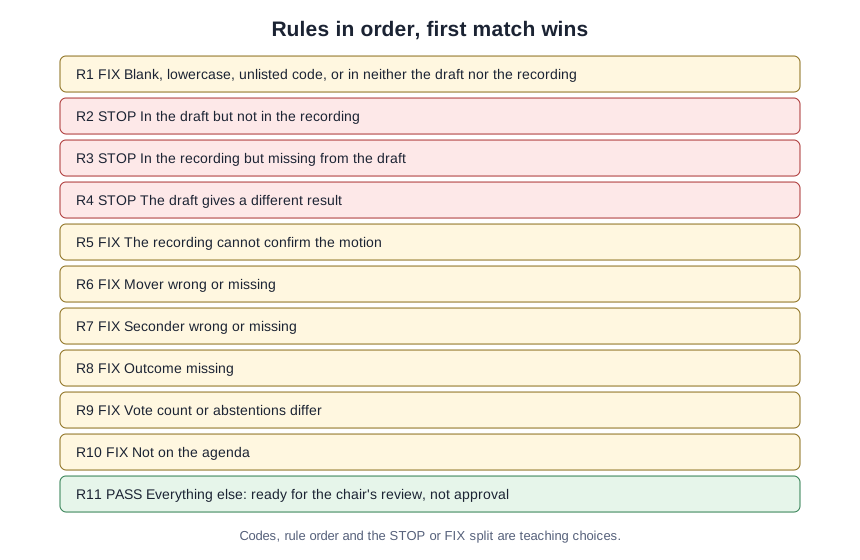
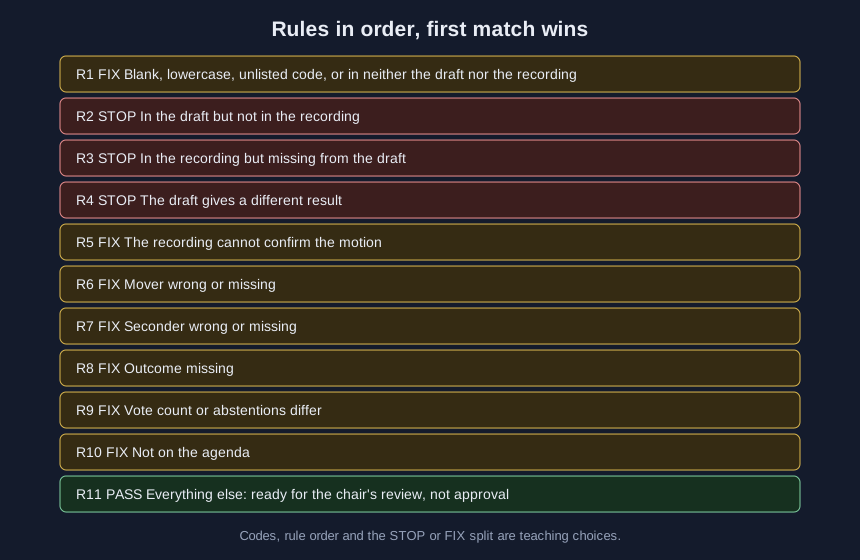
A PASS means the motion is ready for the chair’s review. It is not approval of the minutes and not a ruling on whether the motion was properly made. The codes, the rule order and the split between STOP and FIX are teaching choices; the deck supplies the three items, not the grading.
Two motions worked through
This is a teaching example, not a case study. The motions belong to the Invented Corrimount Association of Respiratory Therapy Educators, which exists only in the lab.
In Case C, Motion 2, the AI draft says “Budget adopted 6 to 2.” At 00:38:55 the recording has the chair saying the budget will be tabled to the December meeting, and “Hearing no objection, it is tabled.” With outcome D and count D, the first rule that fits is R4, a STOP for a result the board never reached, and the page lists R9 under Also matched. Correct the outcome first, then delete the count, since a tabled item had no vote to record.
In Case B, Motion 3, the draft records the preceptor workshop charter as carried, but the chair says at 00:52:10, “No motion today.” In recording N makes it R2, a STOP.
Check your calls against the six cases
Call each motion before the page does, then compare totals.
- Case A, a clean draft: six passes.
- Case B, a motion nobody made: one stop, two fixes, three passes.
- Case C, tabled rather than carried: two stops, one fix, three passes.
- Case D, edge cases: four fixes, two passes.
- Case E, several problems at once: two stops, two fixes, two passes.
- Case F, dropped and mixed up: one stop, three fixes, two passes.
The page works out which motions break more than one rule on every run. Case D rewards a slow read. Its first motion has no second in either the recording or the draft and still passes, because the consent agenda was approved without objection; whether yours needs a second depends on your bylaws and rules of order. Its last motion carries a lowercase “s” and is a FIX for a bad entry, not a match.
Mistakes that survive a quick read
Filling a recording gap from the AI draft. When the audio stopped or several directors talked at once, the summary’s version is not evidence. Use the minute-taker’s own notes or ask the chair.
Writing “carried unanimously” out of habit. A single abstention makes it wrong. Take the count from the recording.
Adding discussion the minutes do not need. The deck notes, “A description of the content/conversation is optional.” Extra paragraphs give an AI more to get wrong.
Treating PASS as a ruling. The lab checks the codes you type. Whether a motion needed a second, or whether an item off the agenda could be taken up, is a question for your bylaws, so check with your counsel or parliamentarian.
Limitations
The lab compares only what you type; it does not play audio or read a transcript. The invented association, its directors and its October meeting are made up. The Oregon deck is a training presentation, not a statute, and it does not cover AI tools. This tutorial is general information, not legal advice.