Tutorial
BeginnerFind Out What an AI Tool Keeps and Trains On From Its Own Terms, and Record It
Read an AI tool's own terms, privacy policy and settings for five answers (what it keeps, for how long, whether it trains on your text, how to opt out, how to delete), then save a dated record your association can re-check. The practice excerpt is invented.
Time needed: About 30 minutes for the first tool, 15 minutes for a re-check
Before you start:
- The name of one AI tool your staff already use or want to use, and the plan or account type you have
- Links to that tool's terms of service, privacy policy and settings page, or use the practice excerpt
- A shared folder where your association keeps tool decisions
AI Literacy Data Privacy Vendor Review Governance
Picture this illustrative case: a professional society’s membership team wants to paste committee notes into an AI chatbot to draft meeting summaries, and the executive director asks one question first: does the tool keep that text or train on it? By the end of this tutorial you will be able to answer from the tool’s own published words and file a dated record of what they said. The reading steps and the record are our recommended practice; no source we found prescribes a procedure for reading an AI tool’s terms.
Why the tool’s own words are the place to start
The voluntary NIST AI RMF Playbook suggests organizations “Review audit reports, testing results, product roadmaps, warranties, terms of service, end user license agreements, contracts, and other documentation related to third-party entities to assist in value assessment and risk management activities.” It also warns that “Risk measurement and management can be complicated by how customers use or integrate third-party data or systems into AI products or services, particularly without sufficient internal governance structures and technical safeguards.” (GOVERN 6.1). A chatbot your staff type into is exactly that kind of third-party system.
What a page says is a statement by the vendor, not a fact we or anyone else has verified. Record it as the vendor’s own words.
The practice excerpt
This is a teaching example, not a case study. “ExampleAI” is invented and describes no real product; every number, setting and plan name in it is made up.
ExampleAI Terms (illustrative, not a real product). 4.1 Inputs. You keep your rights in the text you submit (“Inputs”). 4.2 Use of Inputs. We may use Inputs and outputs to provide, maintain and improve the Service, including to train our models, unless you turn off “Improve the model” in Settings. 4.3 Retention. We keep Inputs for 30 days after deletion from your history, and longer where required by law or to investigate abuse. 4.4 Business accounts. For Team plans, we do not use Inputs to train models. 9. Changes. We may update these Terms; continued use after the effective date means you accept them.
Six steps
-
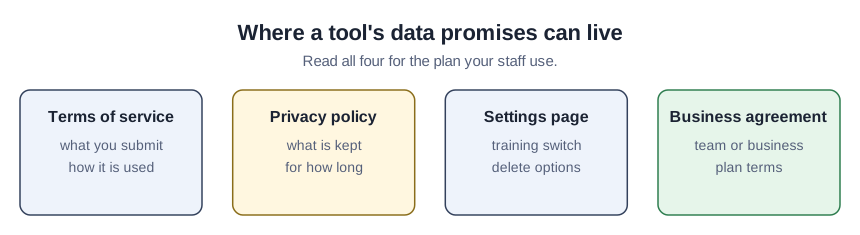
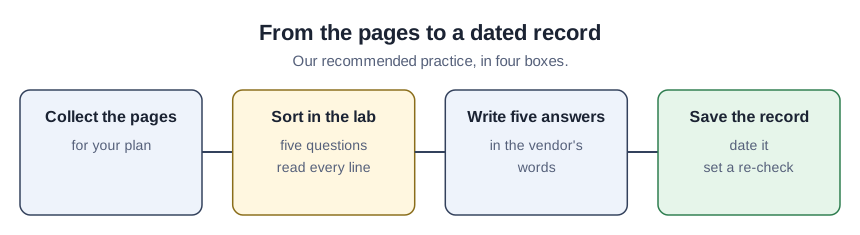
Collect the pages for your plan. Open the terms of service, the privacy policy, the settings or data-controls page, and any business or team agreement. Note which plan your staff actually use, because, as clause 4.4 of the practice excerpt shows, terms can differ by plan.
-
Paste each page into the AI terms check lab. It sorts sentences under five questions: what is kept, for how long, whether your text is used for training, how to opt out, and how to delete. Its sorting is a keyword match, so read every sentence it shows.
Try it now: the AI data trace lab runs fixed keyword rules in your browser, not AI. Load an invented vendor or paste real terms, pick your plan and settings, and watch a simulated trace of where a practice message goes and which copies remain on any day. Nothing you type leaves the page, and the trace is not a legal finding.
-
Write each answer in the vendor’s own words. For the excerpt: training happens unless a setting is off (4.2), text is kept 30 days after deletion with exceptions (4.3), and Team plans are excluded from training (4.4). Copy the clause number with each answer.
-
Mark what the pages do not say. A blank is a finding. If nothing explains deletion, write “not stated.” Deletion matters on your side too: the Playbook lists “Data management, quality, and privacy (e.g. minimization, rectification or deletion requests) controls as part of organizational data governance policies.” (MANAGE 1.3).
-
Read the changes clause. In FTC staff guidance (a staff blog post, not a rule), the FTC’s Office of Technology notes that “companies may try to make these changes surreptitiously” and says “A business that collects user data based on one set of privacy commitments cannot then unilaterally renege on those commitments after collecting users’ data.” Clause 9 of the excerpt lets terms change on use alone, which is why the record carries a date.
-
Save the dated record. Put the tool, plan, page links, capture date, the five answers with clause numbers, and the next re-check date in your own document or spreadsheet. File it next to the tool list in your AI acceptable-use policy.
The excerpt, filled in
| Question | ExampleAI answer (illustrative) | Clause |
|---|---|---|
| What is kept | Inputs and outputs | 4.1, 4.2 |
| For how long | 30 days after deletion, longer for law or abuse | 4.3 |
| Trained on | Yes, unless “Improve the model” is off; not on Team plans | 4.2, 4.4 |
| Opt-out | A Settings switch | 4.2 |
| Delete | Not stated beyond history deletion | 4.3 |
Check your record
- Every answer quotes or cites a clause, or says “not stated.”
- The plan in the record is the plan your staff use.
- The capture date and the page links are filled in.
- A second person read the same pages and agrees with the five answers.
- A re-check date is set.
Where a terms check goes wrong
Reading the consumer terms for a business account. The plan decides which promises apply.
Treating a settings switch as the whole answer. Copy what the written terms say about it, not what the label suggests.
Never looking again. FTC staff say it “may be unfair or deceptive for a company to adopt more permissive data practices” and “to only inform consumers of this change through a surreptitious, retroactive amendment to its terms of service or privacy policy.” That is a warning to companies, not a finding about any tool, but it is a reason to re-read on the date you set.
Sources (2)
- NIST: AI RMF Playbook (companion to the AI Risk Management Framework 1.0, PDF dated August 2024; voluntary suggestions)
- U.S. Federal Trade Commission, Office of Technology and Division of Privacy and Identity Protection staff: AI (and other) Companies: Quietly Changing Your Terms of Service Could Be Unfair or Deceptive (Tech@FTC staff blog post, 13 February 2024; staff guidance, not a rule)