Tutorial
BeginnerRead the BLS Outlook for Your Own Job Before You Plan Around AI
Find your occupation in the Bureau of Labor Statistics' Occupational Outlook Handbook, write down its projected growth, openings, duties and largest employers with the page date, and keep that note as your baseline. The steps are our recommended practice; the BLS pages used here do not mention AI.
Time needed: About 20 minutes for one occupation
Before you start:
- Your job title, or the occupation you advise members about
- A browser to open the Occupational Outlook Handbook (free, no account needed)
- A place to keep a dated note, or the lab's copy button
AI Literacy Workforce Careers Events
Picture this illustrative case: a nonprofit’s development director hears at a conference that AI will hollow out fundraising, and her team asks whether they should be worried. Before anyone answers that, it helps to know what the official outlook for the job says on its own terms. By the end of this tutorial you will have a dated, one-page note of the Bureau of Labor Statistics outlook for your occupation: projected growth, yearly openings, the duties BLS lists and who employs people in the job. The steps and the note format are our recommended practice. The two BLS pages used as examples do not mention AI, so this note is a baseline, not an AI forecast.
Try it now: the job outlook note lab runs in your browser with the event planners’ figures already entered. Type in your own occupation’s figures and it builds the dated note for you. Nothing you type leaves the page. The blank note is yours if you email ai@trihelix.co.
Why a baseline first
Claims about AI and jobs arrive without context. A baseline gives you the numbers the government publishes for the occupation before any AI argument starts, so you can tell whether a claim is describing a change or just restating the job. For what government researchers say about AI’s effect on jobs, read our same-day article on what government labor researchers say AI is doing to jobs. Keep the two apart: the outlook figures below are BLS’s general projections, and nothing on these pages attributes them to AI.
Six steps
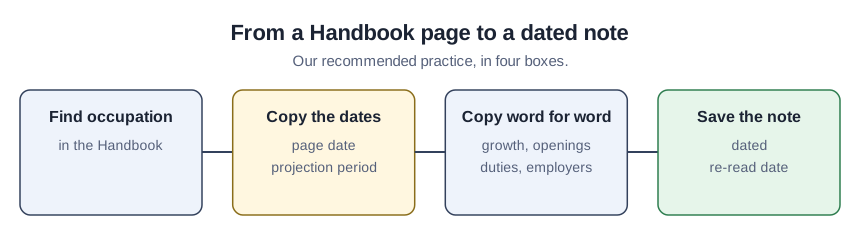
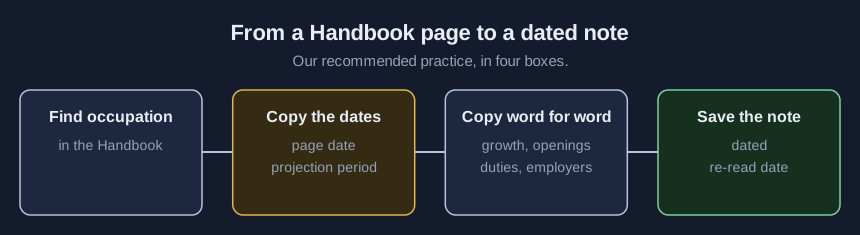
- Find your occupation in the Handbook. Search by job title. Association titles often span several occupations, so pick the page whose duties match most of your week.
- Copy the page date and the projection period. The note is worthless without them, because a later edition may show different figures.
- Copy the growth and openings sentences word for word. Paraphrase is where numbers drift.
- Copy the duties you actually do. Skip the ones you do not.
- Find your sector in the largest employers table. For most associations and nonprofits, the row to check is the one BLS calls “Religious, grantmaking, civic, professional, and similar organizations”.
- Save the note with today’s date and set a reminder to re-read the page next year.
Worked example one: association event planners
This example uses real figures from the meeting, convention and event planners page, which shows “Last modified date: August 27, 2026”. BLS names this exact job: “Association planners organize annual conferences and trade shows for professional associations.”
The outlook section says: “Employment of meeting, convention, and event planners is projected to grow 6 percent from 2025 to 2035, faster than the average for all occupations.” And: “About 16,800 openings for meeting, convention, and event planners are projected each year, on average, over the decade.” In the largest employers table, the row for religious, grantmaking, civic, professional and similar organizations shows 14 percent. One listed duty: “Review event bills and approve payments”.
Worked example two: nonprofit fundraisers
For the development director, the fundraisers page carries the same date. It says: “Employment of fundraisers is projected to grow 6 percent from 2025 to 2035, faster than the average for all occupations.” In its largest employers table, the same row of religious, grantmaking, civic, professional and similar organizations shows 41 percent. One listed duty is “Research prospective donors”. Under important qualities, BLS writes: “Detail oriented. Fundraisers deal with large volumes of data, including lists of people’s names and phone numbers, and must comply with state and federal regulations. Failing to do so may result in penalties.”
That last line is worth keeping in the note. It is not about AI, but it is the first thing to remember when anyone proposes putting a donor list into a new tool.
What the finished note looks like
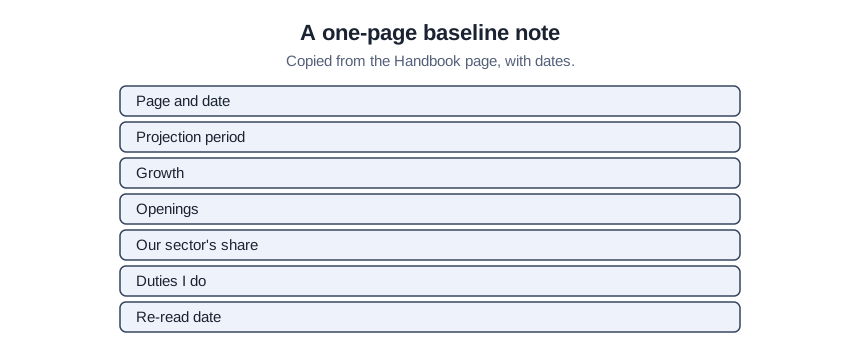
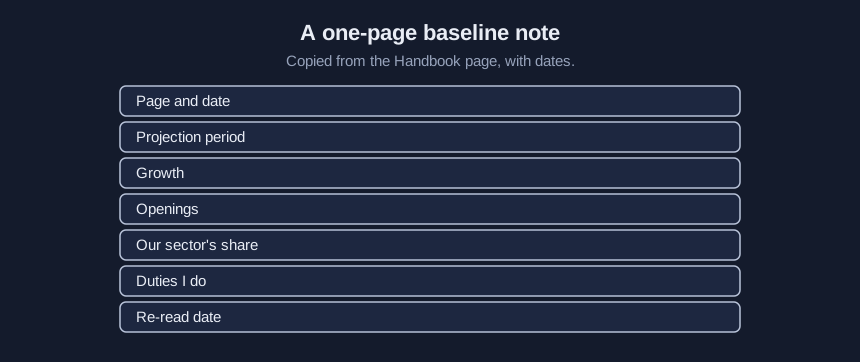
| Field | Event planners (example) |
|---|---|
| Page and date | OOH, meeting, convention and event planners, last modified 27 August 2026, read 22 October 2026 |
| Projection period | 2025 to 2035 |
| Growth | 6 percent, faster than average (BLS wording copied) |
| Openings | About 16,800 a year, on average |
| Our sector’s share | 14 percent in religious, grantmaking, civic, professional and similar organizations |
| Duties I do | Review event bills and approve payments |
| Re-read on | One year from today |
Check your note
- The page date and projection period are on it.
- Every number is copied from the page in BLS’s words.
- The note says nowhere that AI caused or will change any figure.
- A re-read date is set.
Where a baseline note goes wrong
Reading AI into the outlook. These pages do not mention AI. If someone says a projection reflects AI, ask them to show where BLS says so.
Mixing projection periods. A figure from an older edition is not comparable to the 2025 to 2035 numbers. Keep the period next to every figure.
Sources (2)
- U.S. Bureau of Labor Statistics, Occupational Outlook Handbook: Meeting, Convention, and Event Planners (2025 to 2035 projections; page last modified 27 August 2026; read 22 October 2026)
- U.S. Bureau of Labor Statistics, Occupational Outlook Handbook: Fundraisers (2025 to 2035 projections; page last modified 27 August 2026; read 22 October 2026)