Tutorial
BeginnerTie Every Requirement in an AI-Drafted Job Posting to a Task
Before an AI-drafted job posting goes live, list the job's real tasks, link each requirement to one, cut what has no task behind it, rewrite trait words as work, give a required degree an equivalent path, and have the person who knows the job confirm the list.
Time needed: About 20 minutes for one posting
Before you start:
- A job posting drafted with help from an AI tool
- Half an hour with the person who does or supervises the job
AI Literacy Workforce Careers Governance
You have an AI-drafted job posting. By the end of this tutorial every requirement in it will point to a real task in the job, or it will be gone, and the person who knows the job will have confirmed the list.
Try it now: the job posting requirement check lab asks for the job’s tasks first, then each requirement from an AI-drafted posting and the task it supports. It marks every requirement PASS, FIX or STOP, lists tasks with no requirement, and builds a plain-text record to keep with the posting. The Prairie State Association of Respiratory Therapists and its posting are invented for the lab; none of the text is output from an AI tool.
The model we borrow
Federal hiring rules bind federal agencies, not associations, and nothing here is legal advice. The federal rule on employment practices, 5 CFR 300.103, says: “There shall be a rational relationship between performance in the position to be filled (or in the target position in the case of an entry position) and the employment practice used.”
The Office of Personnel Management’s skills-based hiring guidance, issued April 29, 2024, explains how agencies make that link: “A job analysis identifies the job tasks, roles, and responsibilities of the incumbent performing the job, as well as the competencies required for performance, the resources used during performance, and the context (or environment) in which performance occurs.” It adds that “a job analysis demonstrates the clear connection between job tasks and the competencies necessary to perform those tasks.”
Check the posting
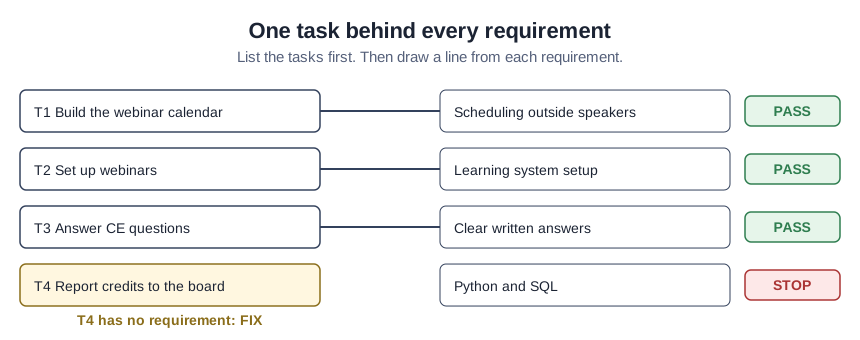
- List the job’s tasks before you open the draft. Write four to ten, with the person who supervises the role. OPM’s guidance calls the right person a subject matter expert: “anyone who has direct, up-to-date experience of a job and is familiar with all its tasks.”
- Paste the draft’s requirements, one per line.
- Link each requirement to a task. “None” is an allowed answer, and it is the point of the exercise.
- Mark each requirement’s kind. Degree, years of experience, certification or license, skill, tool or software, or personal trait.
- Fix what has no task first. Remove it, or add the missing task.
- Rewrite traits as work. Say what the person does, in which task.
- Give a required degree an equivalent path. Add “or equivalent experience,” move it to preferred, or have the job expert say why the task needs the degree itself.
- Question long experience requirements. The lab flags anything over five years. The five-year threshold and the rule order are teaching choices for this lab, not a legal standard.
- Check the other direction. A task with no requirement may need a skill named, or may not belong in the job.
- Have the job expert confirm, and keep the record. OPM’s guidance says documentation of “the linkages between job tasks, competencies, and selection tool content” is essential.
Worked example: the coordinator posting
This is case B in the lab, and everything in it is invented. Marcus Lindqvist, director of education at the Prairie State Association of Respiratory Therapists, is hiring a Continuing Education Program Coordinator. His four tasks: build the quarterly CE webinar calendar with faculty (T1), set up webinars and certificates in the learning system (T2), answer member questions about CE credit (T3), and report credits awarded to the state board each quarter (T4).
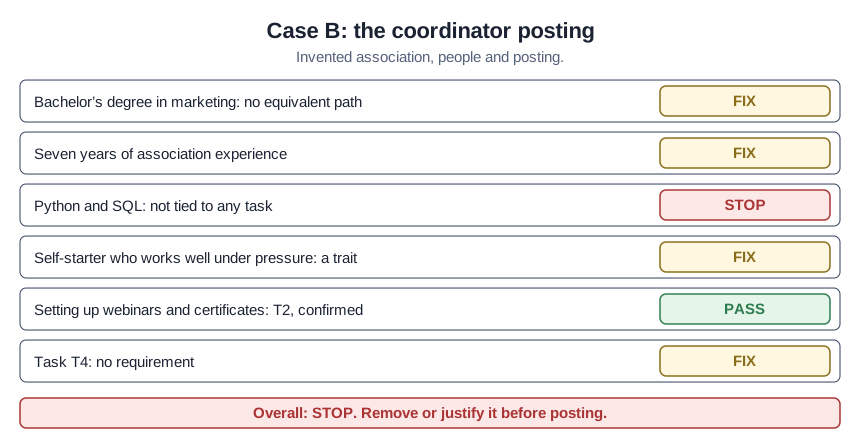
The sample draft lists five requirements.
| Requirement | Result | What the lab says |
|---|---|---|
| Bachelor’s degree in marketing | FIX | “Requirement 1: a required degree with no equivalent path. Add ‘or equivalent experience’ or move it to preferred, unless the job expert can say why T1 needs the degree itself.” |
| Seven years of association experience | FIX | More than five years for answering CE questions (T3). |
| Proficiency in Python and SQL | STOP | “Requirement 3: not tied to any task. Remove it, or add the task it supports to the task list first.” |
| A self-starter who works well under pressure | FIX | A trait, not a task. Rewrite it as what the person does in T1. |
| Experience setting up webinars and certificates | PASS | Tied to T2 and confirmed. |
The task check adds a FIX: T4, the state board report, has no requirement. Marcus adds “accurate record keeping for state reporting,” and rewrites the trait as “keeps the webinar calendar on schedule when faculty change dates.” The overall result before those fixes is “At least one requirement has no task behind it. Remove or justify it before posting.”
Check your result
- Every requirement names a task.
- No requirement describes a personality.
- Every required degree has an equivalent path or a reason.
- Every task has at least one requirement.
- The job expert has confirmed the list, and the record is filed with the posting.
Where a requirement check goes wrong
Starting from the draft. If you write tasks after reading the requirements, you will invent tasks to fit them.
Checking alone. Without the job expert, you are guessing which tasks are real.
Leaving the degree for later. Any screen, human or automated, reads the posting as written.