Article
BeginnerAI-Written Comments Can Pass for Your Members. That Is the Problem.
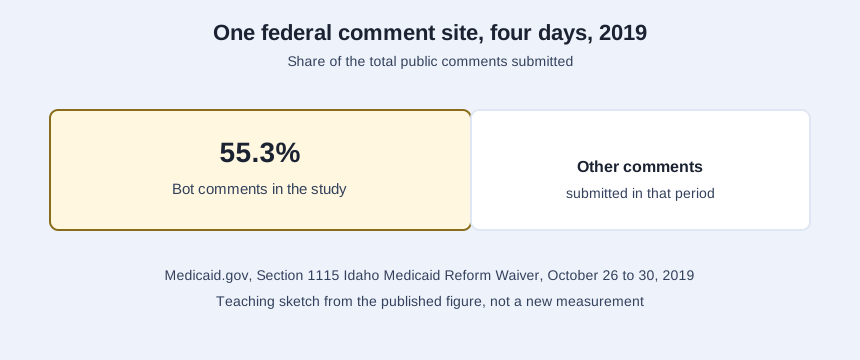
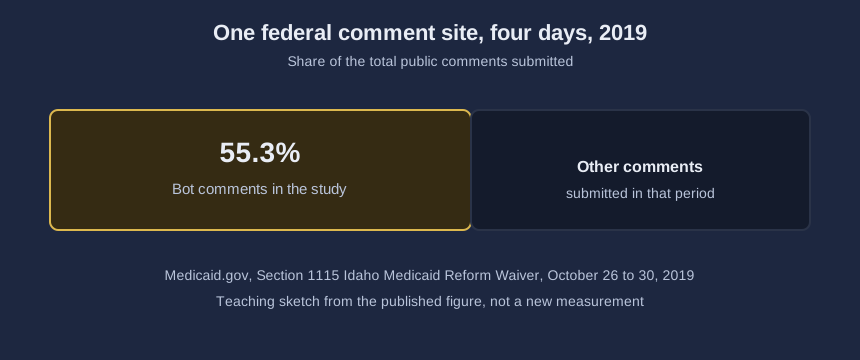
A Harvard student's study published in Technology Science found AI-written comments made up 55.3% of the total public comments submitted to one federal site over four days, and people sorting them did no better than chance.
Advocacy Communications AI Literacy Member Trust
In a Harvard student’s study published in Technology Science, a bot submitted AI-written comments to a federal Medicaid comment website until they made up “55.3% (1,001 out of 1,810) of the total public comments submitted,” then the author withdrew them and told the agency.
That figure is the share of the total public comments submitted, over four days, to Medicaid.gov on the Section 1115 Idaho Medicaid Reform Waiver. The comments went up from October 26 to 30, 2019. The text came from GPT-2, an older model. The author “manually reviewed 2,082 comments and identified 1,001 highly coherent and highly relevant comments for submission.” After the period ended, he withdrew those comments and notified the agency.
If machine-written comments can make up more than half of the total public comments submitted in a short window, and people cannot reliably spot them, a campaign’s headline count proves little. What still carries weight is a real member who approved the comment and said something from their own work.
Consider the Invented Velmorrow Association of Home Health Agencies facing a federal payment rule. This is a teaching example, not a case study. The advocacy director wants every chapter to send comments by Friday. A helper tool offers to write a unique comment for each supporter from a list of names. The drafts would be fluent. The names would be real. The experiences would not. The tempting pitch is that more unique text will look more authentic. Unique wording is not the same as a member’s own account.
What people could not tell apart
The same study asked people to sort comments as bot or human. “When humans were asked to classify a subset of the deepfake comments as human or bot submissions, the results were no better than would have been gotten by random guessing.” Of 198 people who finished the survey, 108 passed a screening test. “On average, the 108 respondents correctly classified 49.63% (Standard Deviation: 10.36%; 95% Confidence Interval: [47.68%, 51.58%]) of comments correctly as being created by a bot or by a human.” They were online survey workers recruited for the study, not agency staff.
The author put the practical point plainly: “Human moderators would have no consistent way of correctly identifying bot comments by hand.”
Some of the human comments in that set still showed leftover form language, including “[Insert Comment Here],” which commenters had not removed. Machine text is not the only way a submitted comment can look templated.
What a campaign can still prove
Volume is cheap once a tool can write many comments that pass as personal. An association that puts its name on generated volume is lending its credibility. That is our reading of the study, not a finding about any vendor, and we do not name any advocacy software.
Count the members who approved a comment under their own name, and keep the sentences that come from their own experience. A tool can help a member tidy words they already wrote. It should not invent the story.
For chapter-led campaigns and state legislative letters, use the same three questions before anyone hits submit. Did this person agree to put their name on this text? Did they write or edit it? Does it describe something that happened in their own work? If any answer is no, the comment should wait.
Sponsored “grassroots” comment tools raise the same question. If the association’s name sits on the batch, a generated comment becomes the association’s comment even when someone else supplied the text. That application is our reading; the study showed that AI-written comments could pass for human ones on one federal site.
If you are still writing the alert that asks members to comment, start with our guide to turning a bill into a member alert. Bots filling an association’s own open survey are a different problem: there the association is the recipient, not the sender. Fake people in member-facing photos and AI stand-in members in research raise a similar trust issue in other channels. To check a queued batch before anything is submitted, use the companion tutorial and check a member comment campaign before it is submitted.
Limits worth saying out loud
The study covers one comment website, one state Medicaid waiver, four days in 2019, and an older model. The comments that went in were the ones the author judged coherent and relevant, not every generated draft. Technology Science describes itself as “a refereed, peer-reviewed online publication forum.” The author was a Harvard College senior at the time. The study did not test association campaigns or today’s writing tools, so this article does not speak for current products. Applying the finding to a member comment campaign is our reading. The Invented Velmorrow Association of Home Health Agencies is made up.