Tutorial
BeginnerKeep a Record of Human Choices on AI-Assisted Work
Record what a person wrote, chose, arranged or changed on each AI-assisted piece, then sort six sample pieces to see which need work before anyone files.
Time needed: About 45 minutes to record six pieces and run the six practice cases
Before you start:
- A list of logos, covers, course text, slides, layouts and photos your association made with AI help
- Access to the drafts and source files for each piece, if they still exist
- The names of the people who worked on each piece
- A browser to run the lab
Copyright Communications Publications Education AI Literacy
By the end you will have a short, dated record for each AI-assisted piece your association publishes, saying what a person wrote, chose, arranged or changed, and you will have sorted six sample pieces into STOP, VERIFY or PASS before anyone files, licenses or promises them to a sponsor.
This is general information, not legal advice.
Try it now: open the AI-assisted work claim sort lab, where an association that does not exist has six practice cases with six pieces in each. Pick a value in each field and the page sorts every piece with fixed rules. Nothing leaves your browser, no AI model is involved, and a result is a teaching sort, not a legal determination.
Why the record has to exist before anyone asks
Months after a logo ships, someone asks which parts a person made, and nobody can say. In the U.S. Copyright Office’s March 2023 registration guidance, the Office says “applicants have a duty to disclose the inclusion of AI-generated content in a work submitted for registration and to provide a brief explanation of the human author’s contributions to the work.” Keeping that explanation as the work happens, rather than rebuilding it later, is our reading of the guidance.
For the two decisions that show where protection stopped in real cases, read our article on AI-made conference logos, covers and course text.
Build the record in seven steps
-
List the pieces. Pick six AI-assisted pieces your association published or is about to publish, such as a logo, cover art, course text or a slide illustration, one row each.
-
Mark how much of the finished piece is AI material. Use None, Some or Most. The Office’s test is about the finished work: “If a work’s traditional elements of authorship were produced by a machine, the work lacks human authorship and the Office will not register it,” says the March 2023 guidance. It calls this “necessarily a case-by-case inquiry,” so the three levels are only a sorting aid.
-
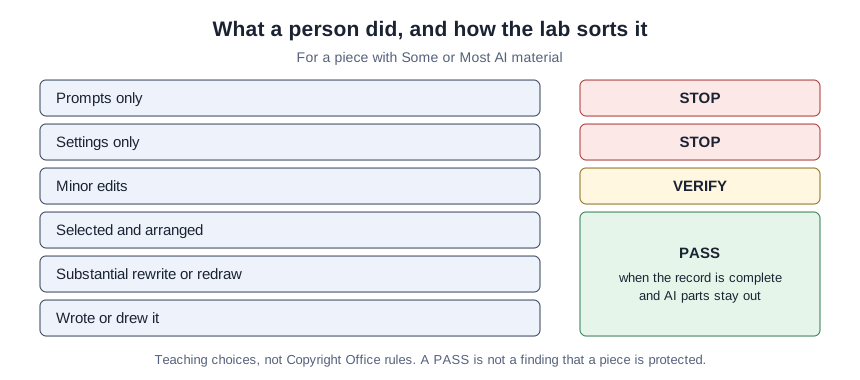
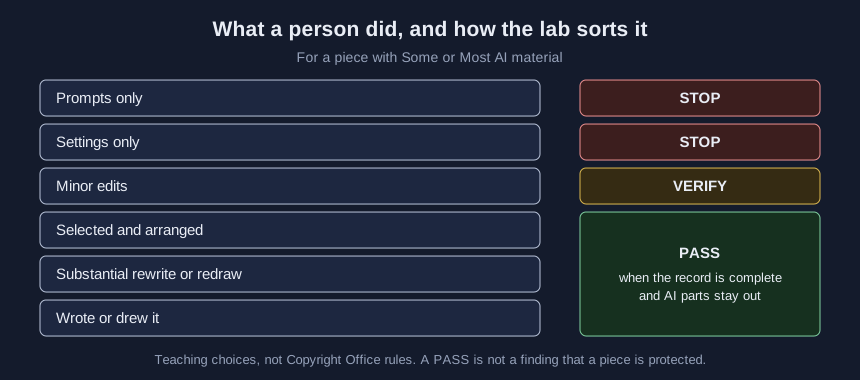
Name the main thing a person did. Choose one: wrote or drew it, substantially rewrote or redrew it, selected and arranged it, made minor edits, wrote prompts only, or chose settings only. The guidance says what counts is “the extent to which the human had creative control over the work’s expression.” On prompts, it says that when a tool receives “solely a prompt,” the tool, not the user, determines and executes the traditional elements of authorship, and that a creative prompt “does not mean that material generated from a copyrightable prompt is itself copyrightable.”
Settings get the same treatment. In the SURYAST decision of December 2023, the applicant fed his own photograph and Van Gogh’s The Starry Night into an app and chose a value for how much style to transfer. The Review Board said “selecting a single number for a style filter is the kind of de minimis authorship not protected by copyright,” and found his part “cannot be distinguished or separated from the final work produced by the computer program.”
-
Write the dated record. Note the date, who worked on it, what the tool produced, and what the person wrote, chose, arranged or changed, with saved versions. The guidance allows that a person may “select or arrange AI-generated material in a sufficiently creative way,” or modify it “to such a degree that the modifications meet the standard for copyright protection,” but “copyright will only protect the human-authored aspects of the work.” The SURYAST applicant sent the Office a 17-page document describing how the app works and how he used it; that is one applicant’s choice, not a length anyone requires.
-
List people as authors, never the tool. The guidance says “Applicants should not list an AI technology or the company that provided it as an author or co-author simply because they used it when creating their work.” The SURYAST application had named the app as an author of the “2-D artwork.”
-
Set the filing plan. Choose not registering, AI parts excluded, or AI parts not excluded. The March 2023 guidance says “AI-generated content that is more than de minimis should be explicitly excluded from the application,” and adds that applicants who are unsure “may simply provide a general statement that a work contains AI-generated material.” If a past registration missed AI content, it says to file a supplementary registration, and warns that applicants who do not update the record “risk losing the benefits of the registration.”
-
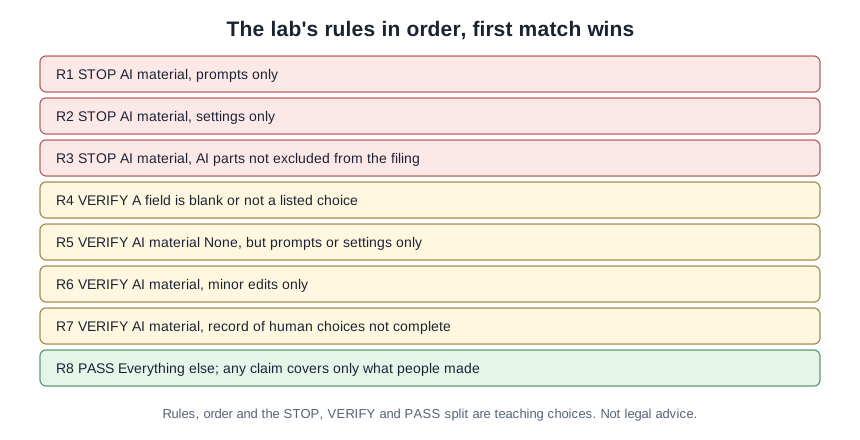
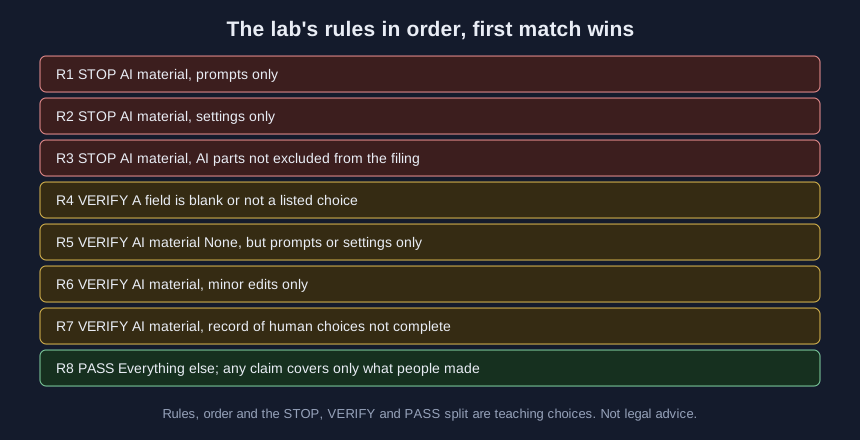
Sort the pieces and fix every STOP. Enter the six rows in the lab, fix the STOPs, finish the records behind each VERIFY, and ask counsel before you register, license or promise a sponsor exclusivity.
One record, filled in
This is a teaching example, not a case study. Below is the record kept for the member magazine cover at the Invented Pellumbra Society of Continuing Education Providers:
Pellumbra record of human choices (invented example)
Piece: Member magazine cover art, spring issue
AI material in the finished piece: Most
Main human contribution: Selected and arranged
What a person did: The editor generated candidate images, chose
  a few, cropped them, placed them in a grid she designed, and
  wrote every cover line herself.
Saved versions: candidate folder, layout draft 1 and 2, final file,
  each dated
Author listed: the editor (the tool is not listed as an author)
Filing plan: AI parts excluded; claim limited to the selection and
  arrangement and the cover text
Not legal advice. Counsel reviews before any filing or license.
In the lab this row is Piece 2 in Case A, and it passes under R8 because a person’s selection and arrangement is named and the generated images stay out of the claim.
Two pieces that stop
In Case B, Piece 2, the cover is Most AI material, the editor only wrote prompts, and no record exists. R1 fires first, a STOP, and R7 is listed as also matched for the missing record.
In Case F, Piece 4, the slide illustration is Most AI material and the filing plan leaves the AI parts in the claim. R3 fires, a STOP, with R7 also matched, so fixing the filing plan alone still leaves a VERIFY until the record is finished.
Six cases to check your sorting
Sort each case yourself first; the table gives the totals the lab computes.
| Case | STOP | VERIFY | PASS |
|---|---|---|---|
| A, everything recorded | 0 | 0 | 6 |
| B | 2 | 1 | 3 |
| C | 1 | 3 | 2 |
| D | 1 | 3 | 2 |
| E | 2 | 2 | 2 |
| F | 1 | 3 | 2 |
The lab also counts pieces that break more than one rule; across the six cases there are six. In Case C, Piece 1 has a blank AI field, and a blank never counts as None.
Where records of human choices go wrong
Writing the record after someone asks. By then it is a guess.
Counting hours of prompting as authorship. In the Copyright Office’s comic book letter covered in the companion article, significant time and effort working with the tool did not make the applicant the author of the images.
Listing the tool as a co-author. It feels honest, but the guidance asks for people as authors.
Reading a PASS as a finding that a piece is protected. A PASS means the record and filing plan line up with the lab’s rules. Whether anything is protected is for the Office, a court or counsel to say.
What the lab does not decide
The lab sorts only the choices made on the page and stores nothing. Its rules, their order and the STOP, VERIFY and PASS split are teaching choices, not Copyright Office rules. Applying the March 2023 guidance and the SURYAST decision to association work is our reading. Rights between your association and the people who made a piece depend on contracts and employment, which are questions for counsel.
Sources (2)
- U.S. Copyright Office: Copyright Registration Guidance: Works Containing Material Generated by Artificial Intelligence, statement of policy, 88 FR 16190 (Federal Register, March 16, 2023)
- U.S. Copyright Office Review Board: Second Request for Reconsideration for Refusal to Register SURYAST, December 11, 2023