Article
BeginnerWhen AI Made Most of the Conference Logo, What Can Your Association Claim?
Two Copyright Office decisions show protection followed what a person wrote, chose and arranged, not what the AI tool generated. Not legal advice.
Copyright Communications Publications Events AI Literacy
The new conference logo came out of an image generator after an afternoon of prompts, the magazine cover was made the same way, and the education department is building a course module from chatbot text. Then the questions start: can the association register these pieces, can a chapter or a sponsor reuse them, and what stops a stranger from copying them?
This is general information, not legal advice.
The quick answer is too blunt to plan with
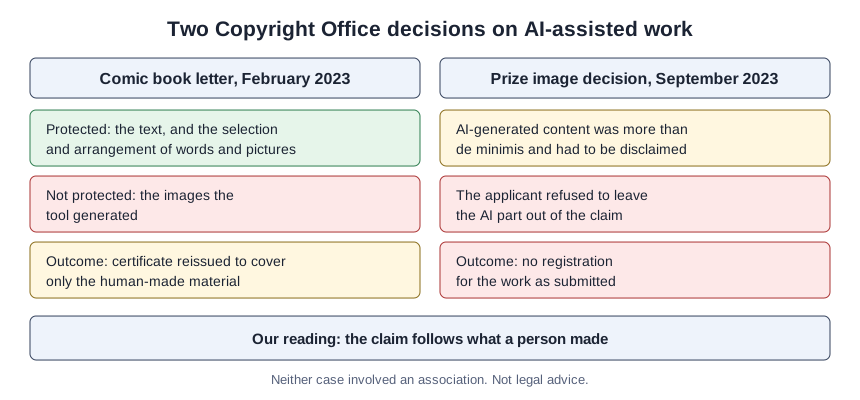
The answer staff usually hear is that nothing made with AI can be protected. In a February 2023 letter about a comic book and a September 2023 Review Board decision about a prize-winning image, the U.S. Copyright Office drew a finer line than that. What a person wrote, selected and arranged kept its protection. The images the tool produced did not, and an applicant who would not separate the two walked away with no registration at all.
Neither case involved an association, so wherever we apply them to logos, covers and courses below, that is our reading.
The comic book: the words and the layout stayed in
The Zarya of the Dawn letter dealt with a registration the Office had already granted for a comic book of eighteen pages, including the cover, with text the applicant wrote and images made with Midjourney. The original application “did not disclose that she used artificial intelligence to create any part of the Work,” according to the letter.
The Office split the book in two. It concluded that the applicant was the author of the text and of “the selection, coordination, and arrangement of the Work’s written and visual elements,” and added, “That authorship is protected by copyright.” On the other side of the line, it found that “the images in the Work that were generated by the Midjourney technology are not the product of human authorship.” Its fix was to cancel the certificate and issue a new one “covering only the expressive material that she created.”
The Office did not doubt that the applicant “expended significant time and effort working with Midjourney,” yet it held that the effort did not make her the author of those images. Small edits did not rescue them either: the letter calls changes to a character’s mouth “too minor and imperceptible to supply the necessary creativity for copyright protection.” It also hedged: “It is possible that other AI offerings that can generate expressive material operate differently than Midjourney does.”
The prize painting: a claim that would not let go of the AI part
The Review Board’s Théâtre D’opéra Spatial decision describes it as “the first AI-generated image to win the 2022 Colorado State Fair’s annual fine art competition.” The applicant built it in Midjourney, then used Adobe Photoshop “to remove flaws and create new visual content” and ran an upscaling tool. He told the Office he had to “input numerous revisions and text prompts at least 624 times to arrive at the initial version of the image,” as the Board’s decision quotes him. That count is his own account, quoted by the Board, not a Board finding.
The Board wrote that his “sole contribution to the Midjourney Image was inputting the text prompt that produced it.” It found more than a de minimis amount of AI-generated content in the image, said that content had to be disclaimed, and concluded: “Because Mr. Allen is unwilling to disclaim the AI-generated material, the Work cannot be registered as submitted.”
The Board left one door open. It said it “does not decide whether Mr. Allen’s adjustments made in Adobe Photoshop would be copyrightable on their own,” and that with the AI material disclaimed he could file again and explain why his changes count as authorship.
What the two cases have in common
In our analysis, protection followed the parts a person made: words, choices about which images go where, and edits large enough to count. Effort spent prompting was not authorship in either case, however long it took. Leaving generated material inside the claim cost one applicant part of a certificate and the other his registration.
Three pieces at an invented association
Here is a teaching example, not a case study, built on a made-up group, the Invented Pellumbra Society of Continuing Education Providers, with three pieces in question.
The annual conference logo came from prompts, and a designer then nudged the colors. In our reading, that is closest to the comic book’s images, and the color change looks more like the mouth edit than like authorship. Pellumbra should not tell a sponsor the mark is protected.
The member magazine cover uses four generated images that an editor chose, cropped and set beside cover lines she wrote. Here the Zarya split is useful: in our reading, the editor’s text and her selection and arrangement are what a claim could cover, and the four images stay outside it.
The course module began as chatbot text. Where an instructor rewrote it into her own explanations, the rewritten text is the human part. Where the module is still mostly tool output with light edits, that is the weak spot. Neither decision involved course content, so this, too, is our reading.
What to do before anyone files, licenses or promises exclusivity
Find out, piece by piece, what a person actually made, and write it down while the files still exist. Say plainly that the AI material is there, and keep it out of any claim. Our companion tutorial on keeping a record of human choices on AI-assisted work walks through that record and includes a lab that sorts six sample pieces. For what copyright covers in the first place, see our post on sharing association materials openly.
Sponsors sometimes expect exclusive use of a conference mark, and promising exclusivity in something nobody can claim is a risk to raise before the contract. No source here addresses sponsors; that is our reading.
What these decisions leave open
Each decision covers one work, and the comic book letter speaks about one tool as it worked then. Neither says anything about rights between an association and the staff member, freelancer or sponsor who made a piece; those questions run through contracts and employment, so take them to counsel. The same goes for any plan to register, license or sell AI-assisted work.
Sources (2)
- U.S. Copyright Office: letter on Zarya of the Dawn (Registration # VAu001480196), February 21, 2023 (a letter from the Office to the applicant's counsel, not a court ruling)
- U.S. Copyright Office Review Board: Second Request for Reconsideration for Refusal to Register Théâtre D'opéra Spatial, September 5, 2023