Article
BeginnerWhen Every Member Uses the Same AI Pricing Tool
When every member gets a price suggestion from the same AI tool, studies of algorithmic pricing show what can happen to margins. What to do instead.
AI Literacy Governance Membership Surveys
The vendor that hosts your member benchmarking dashboard offers an AI add-on: each member would see a suggested price built from everyone’s submissions. It looks like a natural next step for a program members already pay for, and the shortcut staff reach for is that members still set their own prices and nothing leaves the program except in aggregate. That shortcut does not settle the question, because the risk is not only an agreement among members. It is what happens when every competitor in a market takes price advice from the same tool.
When every seller in a market uses the same tool
In Assad, Clark, Ershov and Xu’s study of German retail gasoline covering about 14,500 stations from January 2016 to December 2018, local markets of two or three stations where every station had adopted algorithmic pricing saw margins rise 3.2 cents per litre relative to markets where no station adopted, with adoption inferred from breaks in pricing behavior rather than observed; that study looked at gasoline pricing software, not association member surveys.
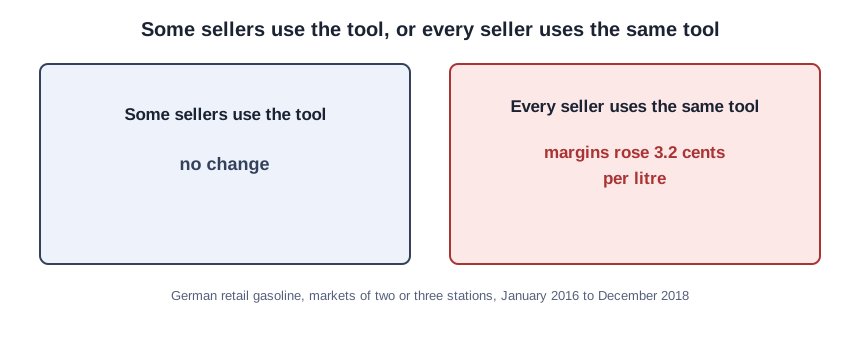
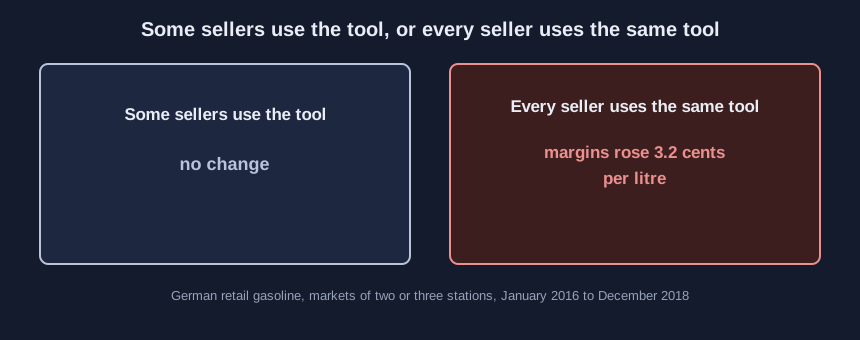
The same study found that markets where only some of the stations adopted saw no change, and neither did adopting stations with no local competitor. Margins started to climb only about a year after every station in a market had adopted, which the authors read as the algorithms learning tacitly collusive strategies. They could not see which algorithm each station used, they write.
Calvano, Calzolari, Denicolò and Pastorello built AI pricing agents and let them compete in computer-simulated marketplaces; the agents consistently learned to charge supra-competitive prices without communicating with one another, and no one designed or instructed them to collude. Their baseline market had two sellers, and the degree of collusion fell as competitors were added but stayed substantial with three or four, the authors report. They call their conclusions necessarily tentative and their model quite highly stylized, they write.
Why this lands on the association’s desk
The gasoline authors also consider competitors who hand their pricing to a common algorithmic software provider, one of a broader set of collusion-facilitating devices that do not require a conspiracy. Both teams point to the same gap, also discussed in the simulation paper: antitrust policy typically targets explicit agreements, and tacit collusion is difficult to prove because it does not rely on explicit communication. So the absence of an agreement among your members is not a comfort. If the association’s program is what hands every member the same suggestion, the program is the common source, and that last step is our reading of the same condition, not a finding in either paper. The gasoline authors conclude that regulators should be concerned about mass adoption of algorithmic pricing software, and they note that their evidence is particular to German retail gasoline markets.
Keep the program to reporting, not recommending
Our advice is to keep the benchmarking program to reporting, not recommending. Decline a per-member price suggestion, even when members can ignore it. Take the vendor’s offer to the association’s antitrust counsel before any pilot starts. The companion tutorial on sorting each member benchmarking output walks through that check, output by output.
One annual report, and one add-on
This is a teaching example, not a case study. Picture the fictional Invented Prandlewick Association of Commercial Laundries, which already sends members an annual price report in aggregate. The vendor now offers a “suggested rate” tile on each member’s dashboard, built from the same submissions. The annual report is still a report. The tile is a recommendation to every competitor who turns it on, and that offer goes to counsel before anyone flips the switch.
A short caution
The evidence we read is from one fuel market and one computer simulation. Neither paper studied associations, member surveys or pay. The lack of a study about association benchmarking is not evidence that the same condition is safe.
Sources (2)
- Emilio Calvano, Giacomo Calzolari, Vincenzo Denicolò and Sergio Pastorello (University of Bologna; Toulouse School of Economics; European University Institute; CEPR): Artificial Intelligence, Algorithmic Pricing, and Collusion (American Economic Review 110(10), 2020, pp. 3267-3297; peer-reviewed; DOI https://doi.org/10.1257/aer.20190623)
- Stephanie Assad, Robert Clark, Daniel Ershov and Lei Xu (Competition Bureau Canada; Queen's University; UCL School of Management; IESE Business School): Algorithmic Pricing and Competition: Empirical Evidence from the German Retail Gasoline Market (Journal of Political Economy 132(3), 2024, pp. 723-771; peer-reviewed; DOI https://doi.org/10.1086/726906)