Article
BeginnerWhen a Leader's Call Breaks Up and the Request Moves to Text
Federal sources describe a leader's call that breaks up, then a push for money in text or chat. Why that switch, more than the voice, is the cue to hang up and call back.
Operations Finance Fraud Security AI Literacy
In a September 2023 information sheet, the National Security Agency, the FBI and the Cybersecurity and Infrastructure Security Agency describe an attempt from May 2023 in which someone imitating a company executive reached an employee on a poor-quality audio call, suggested a video meeting that “appeared to show the executive in their office,” and then gave up on the meeting. In the sheet’s words, “The connection was very poor, so the actor recommended switching to text,” and from there the actor pressed the employee to wire money. The employee grew suspicious and ended the conversation.
Nothing in the sheet says the employee spotted a fake voice or face. The cue was the request and the way it moved off the call. At an association, the person on that call is usually whoever pays vendors or edits a payee’s bank details, an executive assistant relaying the director’s instructions, or someone who helps colleagues sign in to the membership system. Each can learn to notice a call that breaks up and turns into a request in text.
A morning at an invented association
An accounts payable coordinator at the Ombervale Association of School Facility Managers gets a video call that shows the executive director’s face. The audio drops in and out. The “director” says the line is hopeless, moves to the meeting chat, and asks for a same-day payment to a vendor the coordinator has not paid before. This is a teaching example, not a case study. The request has left the call for the chat window, on a channel the coordinator did not choose, and that move is the cue to stop.
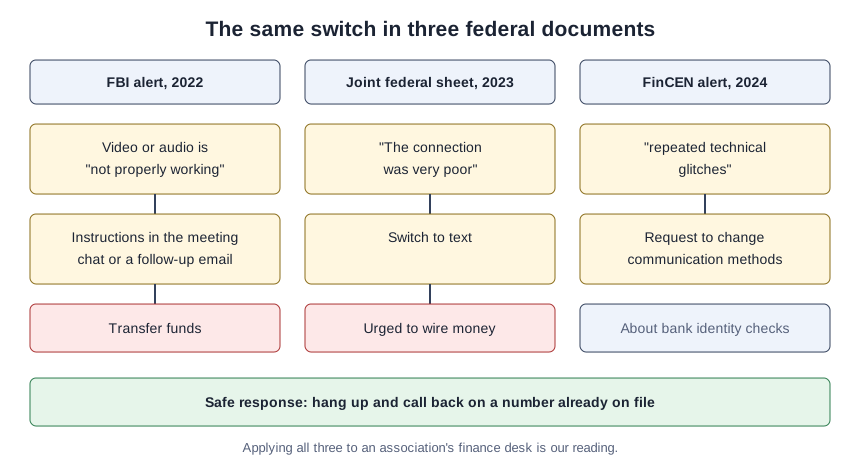
The same switch in three federal documents
The joint sheet lists techniques that “impersonate leaders and financial officers” among the most substantial threats from synthetic media, by audio, video or text, used to “illegitimately authorize the disbursement of funds.” The same list includes fraudulent messages meant to get into an organization’s networks, which is why a request for a sign-in code belongs in the same conversation as a request for a wire. The sheet was written with national security and critical infrastructure in mind, a wider set than associations, but its advice is addressed to organizations generally.
Its other May 2023 example is the one people expect: a manager invited to an interactive call with someone claiming to be the chief executive, where “The voice sounded like the CEO.”
In February 2022 the FBI was already describing the switch. Its alert on virtual meeting platforms explains how criminals who have taken over an executive’s email invite employees to a meeting, show a still picture of the chief executive with no audio or with faked audio, and “claim their video/audio is not properly working.” The instructions to move money then arrive “via the virtual meeting platform chat or in a follow-up email.”
The third description comes from a different setting. FinCEN’s November 2024 alert is written for banks, and it is about people using fake identities when a bank checks who they are. FinCEN says such a person “may claim to be experiencing repeated technical glitches or request to change communication methods during a verification check.”
Three documents, three settings, one move: the live channel fails, and the request continues somewhere easier to fake. We read that as the most teachable moment in this kind of fraud. A call that breaks up is a reason to hang up and call back on a number you already have, not a reason to carry on in chat.
Why careful listening is a weak plan
The joint sheet describes a trend toward synthetic audio that captures a person’s voice “with just a few seconds of reference data.” Leaders who speak on webinars and conference panels have left plenty of that, like anyone who speaks in public; that is our reading, not a claim that associations are singled out.
The FTC has looked at detection directly. In a July 2024 comment to the Federal Communications Commission summarizing its Voice Cloning Challenge, the FTC wrote that scammers can clone the voices of a company’s executives “to make phishing calls leading to unauthorized wire transfers.” It added that early investigation “revealed widely varying notions about how effective voice cloning detection solutions may be,” while cloning “is rapidly improving and becoming easier to use.” The Challenge results, it said, show “there is no single solution to this problem.”
So the rule should turn on what is being asked for and the channel it arrives on, and it has to give the same answer when the caller really is the executive director.
What the sheet asks organizations to do
The joint sheet calls verification steps “especially important when considering procedures for the execution of financial transactions.” It recommends tabletop exercises that “include executives who may be prime targets,” and says employees should know “the mechanisms for reporting this activity within their organization.” For a small staff, that turns into three moves:
- Write down that every payment, payee bank change and sign-in code asked for by phone call, voice message or video call waits for a callback on a number already on file. Our companion tutorial on writing a callback rule walks through it and includes a lab with six practice cases.
- Rehearse once with the executive director and the board treasurer, the voices most worth imitating, and have them say out loud that they expect to be called back.
- Tell everyone where to report a call that felt wrong.
Sponsors and exhibitors get invoices and bank details from an association too. Telling them in writing that the association never changes its own bank details by phone or video call, and that they should call a number from their contract, is the same rule from their side. No source here addresses sponsors; that is our reading.
For reported business email compromise figures and what to do right after a bad transfer, see our post on payment fraud at the association finance desk.
What these sources do not tell us
None of the four documents studied associations, and none says how often this happens. FinCEN’s glitch pattern comes from bank identity checks, not calls to employees. Applying all four to an association’s finance desk is our reading.
Sources (4)
- National Security Agency, Federal Bureau of Investigation and Cybersecurity and Infrastructure Security Agency: Contextualizing Deepfake Threats to Organizations (Cybersecurity Information Sheet U/OO/199197-23, September 2023; written with national security systems, the defense industrial base and critical infrastructure in mind)
- FBI Internet Crime Complaint Center: Public Service Announcement I-021622-PSA, Business Email Compromise: Virtual Meeting Platforms (February 16, 2022)
- Federal Trade Commission: Comment of the Federal Trade Commission, CG Docket No. 23-362, filed with the Federal Communications Commission (July 29, 2024; summarizes the FTC Voice Cloning Challenge)
- U.S. Department of the Treasury, Financial Crimes Enforcement Network: FIN-2024-Alert004, FinCEN Alert on Fraud Schemes Involving Deepfake Media Targeting Financial Institutions (November 13, 2024; written for banks and other financial institutions)