Tutorial
BeginnerWrite a Callback Rule for Any Payment, Bank Change or Code Asked For by Phone or Video
Write a one-page rule for payments, payee bank changes and sign-in codes requested by phone call, voice message or video call, then test it on six practice cases.
Time needed: About 40 minutes to draft the rule and run the six practice cases
Before you start:
- Your current steps for approving payments, even if they are informal
- The names of everyone who can approve a payment or a payee bank change
- Where your on-file numbers for staff, board officers and vendors are kept
- A browser to run the lab
Operations Finance Fraud Security AI Literacy
By the end you will have a short written rule for every payment, every change to a payee’s bank details and every request for a sign-in code or password that arrives by phone call, voice message or video call, and you will have tested it on six practice cases. Each sample request ends as STOP, VERIFY or PASS.
Try it now: the callback rule check lab holds six practice cases, six requests each, for an association that does not exist. Choose a value in each field and the page computes a verdict for every request. Nothing leaves your browser, no call is placed, and no AI model is involved.
Why the rule has to be written before the call
A request in the executive director’s voice is polite, urgent and familiar, and “I’ll call you back” can feel like insubordination. Without a written rule, each person decides alone, under pressure. The FTC’s guide for small businesses and nonprofits puts the scammer’s aim plainly: “They want you to act before you have a chance to check out their claims. Don’t let anyone rush you to pay or to give sensitive business information.” With a rule agreed in advance, the person on the phone is following policy, not doubting the boss.
For why a call that breaks up and moves to text deserves special suspicion, read our article on that pattern.
Build the rule in seven steps
-
Name what the rule covers. Payments, payee bank changes, and sign-in codes or passwords, whenever someone asks for them by phone call, voice message or video call. The FBI’s December 2025 alert says impersonators “have sent text messages and AI-generated voice messages” while posing as senior U.S. officials. That alert is written for individuals; applying it to association staff is our reading.
-
Codes are never given out. No one reads out or types a sign-in code or password for a caller, even after a callback. The FTC guide says to “Train employees not to send passwords or sensitive information by email, even if the email seems to come from a manager.” The FBI alert describes impersonators asking people to “Provide an authentication code” and says, “Never provide a two-factor code to anyone over email, SMS/MMS text message, or encrypted messaging application.” Both sources name written channels. Extending “never share codes” to phone and video calls is our teaching choice.
-
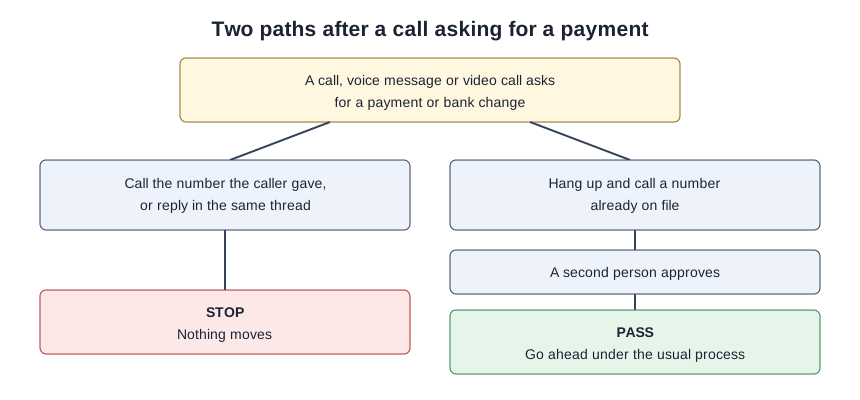
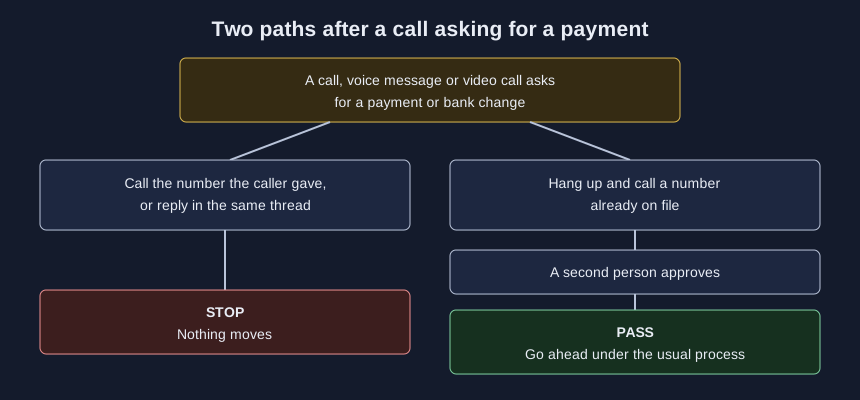
Hang up and call back on a number you already had. The FBI alert says to verify a new number or platform “through a previously confirmed platform or trusted source,” and when someone asks for money, to “independently confirm their contact information prior to taking action.” The FTC guide adds, “Since scammers often fake their phone numbers, don’t trust caller ID.” So the number the caller offers does not count, and neither does a reply in the same chat or thread. To confirm a vendor’s new bank details, follow the steps in our finance-desk post.
-
Add a second approver for payments and bank changes. The FTC guide asks organizations to “Make sure procedures are clear for approving purchases and invoices and ask your staff to check all invoices closely,” and to encourage employees “to talk with their coworkers if they suspect a scam.” Requiring a second person before money or bank details move is our teaching choice; neither source says two people.
-
Treat secrecy as a stop sign. The FTC guide warns about “a call that seems to come from a trusted source,” for example “a supervisor or other senior employee,” “that creates urgency or fear.” Urgency alone does not break the rule if the callback and approval happen. A request to keep it quiet or skip approval stops everything; that is our reading of the guide.
-
Watch for moved channels on other requests. When a known contact suddenly uses a new number, app or chat, or blames a bad line and moves to text, confirm through the channel you already had, even if no money is involved.
-
Put it on one page and test it. Write the rule in plain sentences, send it to everyone who pays, approves or resets accounts, and run the six cases in the lab. For an optional line on payment methods, the FTC guide says, “If someone demands that you pay with a wire transfer, cryptocurrency, or gift cards, don’t pay.”
The rule, filled in for an invented association
This is a teaching example, not a case study. The Ombervale Association of School Facility Managers is invented, and so is its rule:
Ombervale callback rule (invented example)
Covers: any payment, payee bank change, or sign-in code or password
asked for by phone call, voice message or video call, from anyone,
including the executive director and board officers.
1. Codes and passwords: never read out or typed for a caller. End the
   call and tell the IT lead.
2. Payments and bank changes: hang up and call back on the number in
   the staff, board or vendor file. Not the number the caller gives,
   not a reply in the same chat.
3. A second staff member approves before any money or bank detail moves.
4. "Keep this between us" or "skip the usual approval" stops everything.
   Report it to the finance director.
5. A known contact on a new number, app or chat: confirm through the
   channel already on file before acting.
Leaders have agreed in writing to expect a callback every time.
Three requests worked through
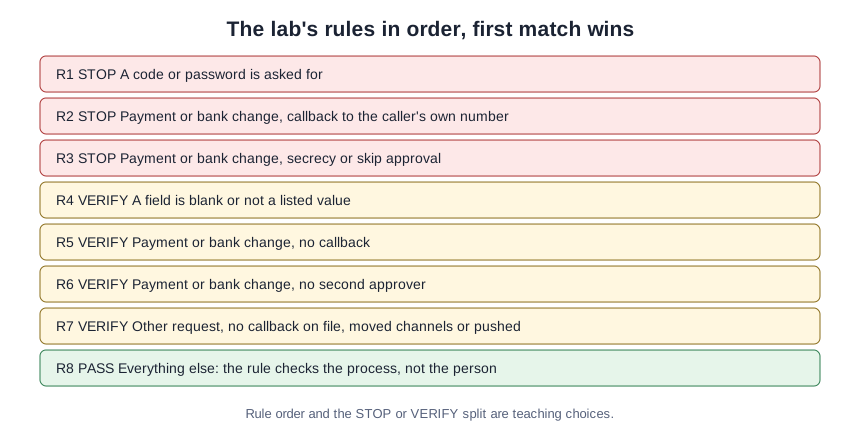
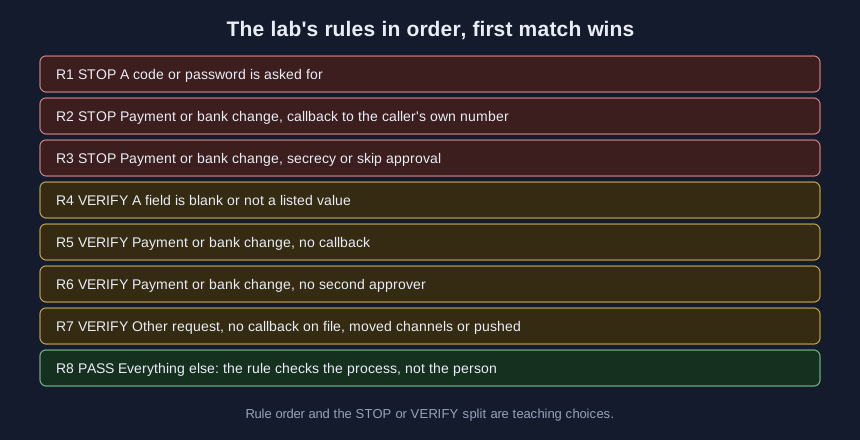
In Case B, Row 1, a payment request came by phone and the coordinator called back the number the caller left. No second person approved. The first rule that fits is R2, a STOP, because calling the caller’s own number is not a callback; the page lists R6 under Also matched for the missing approver.
In Case E, Row 5, a video call asked for a bank change, nobody called back, and the caller asked to keep it quiet. R3 fires first, a STOP, with R5 also matched.
In Case F, Row 4, a phone call asked for something other than money or a code, and the coordinator returned it on the number given. Nothing pushed for speed or a new channel, so it passes under R8.
Six cases to test your judgment
Decide each verdict yourself first, then compare with the page.
- Case A, the rule followed throughout: six passes.
- Case B: two stops, one verify, three passes.
- Case C: one stop, three verifies, two passes.
- Case D: one stop, two verifies, three passes.
- Case E: two stops, two verifies, two passes.
- Case F: one stop, two verifies, three passes.
The lab counts the requests that break more than one rule each time it runs; across the six cases there are four. In Case C, Row 1 has a blank channel, and a blank is never treated as an answer.
Where callback rules fail in practice
Calling back the number the caller just gave. The caller chose it, so it proves nothing.
Asking a security question instead of hanging up. In our reading, a quiz keeps the caller in control of the channel. Dial out instead.
Letting urgency override the rule. Urgency is a cue to slow down, not a reason to skip steps.
Reading a PASS as proof of identity. The lab checks whether the process was followed, not who was on the line.
What the lab does not cover
The lab grades only the choices made on the page and stores nothing. Its rule order and the STOP and VERIFY split are teaching choices. The FBI alert concerns impersonation of senior U.S. officials. Nothing here is legal advice.
Sources (2)
- Federal Trade Commission: Scams and Your Small Business, A Guide for Business (July 2023; written for small businesses and nonprofit organizations)
- FBI Internet Crime Complaint Center: Public Service Announcement I-121925-PSA, Senior U.S. Officials Continue to be Impersonated in Malicious Messaging Campaign (December 19, 2025; written for individuals)